
rSIM in Action: Real-World Outage Detection Explained
Connectivity resilience is often discussed in theory. Uptime figures are quoted, failover is promised, and redundancy is assumed. What is rarely shown is what actually happens during a real network event, and how a SIM and device behaves when connectivity begins to fail.
Rather than focusing on architecture or capability alone, this article looks at how rSIM performs during a live network outage. The data presented highlights how issues develop, how they are detected, and what impact that has on maintaining service in a critical IoT environment.
Understanding Real Network Failures
Not all network failures present as clear, large-scale outages. Many develop as partial or intermittent issues that are harder to detect and resolve. In these situations, devices may remain attached to the network and continue to show signal, while the data session becomes unstable or stops passing traffic altogether.
For the end user, the outcome is the same. The service is no longer working as expected, even though it may still appear connected. These types of failures often sit upstream and beyond the radio layer and do not always trigger an obvious loss of service.
Common examples of these failures include:
Configuration or change-related errors during maintenance or upgrades
Software or firmware faults affecting core network functions
Signalling surges and congestion that prevent stable session establishment
Routing, transport, or core service issues that interrupt data flow
Power or hardware failures affecting sites or network infrastructure
Backhaul and fibre disruption, including failures in third-party infrastructure
A Step-by-Step View of a Real Outage
Using live deployment and monitoring data, it is possible to break down the sequence of events during a recent network outage and examine how rSIM responds at each stage.
At the outset, devices were operating normally on the primary network. As designed, rSIM was continuously testing the connection in the background, verifying that data was passing correctly.
Time | MNO Timeline | rSIM Timeline |
| 11:58 pm | Intermittent connectivity issues start to occur | rSIM polls start failing and experiencing connectivity issues |
| 12:03 am | rSIM determines outage + triggers switch to backup profile | |
| 12:04 am | Connectivity restored to switched rSIMs | |
| 12:13 am | rSIM polling resumes – Traffic resumes via 2nd MNO profile | |
| 12:20 am | Time event first detected by MNO | rSIM maintains service without interruption |
| 1:19 am | ||
| 1:19 am | Outage first reported to customers by MNO – no formal resolution yet | |
| 2:21 am | Time root cause and mitigation reported by MNO | |
| 2:30 am | MNO identifies and resolves root cause | |
| 9:49 am | rSIMs start gradual fallback, avoiding signalling surges | |
| 2:15 pm | rSIMs finish fallback |
Because rSIM actively validates the data and voice connection, in this live case, it was able to identify that the data path was no longer performing as expected. Once the issue was confirmed, the SIM initiated a switch to its secondary operator profile, which is hosted on an entirely separate core network.
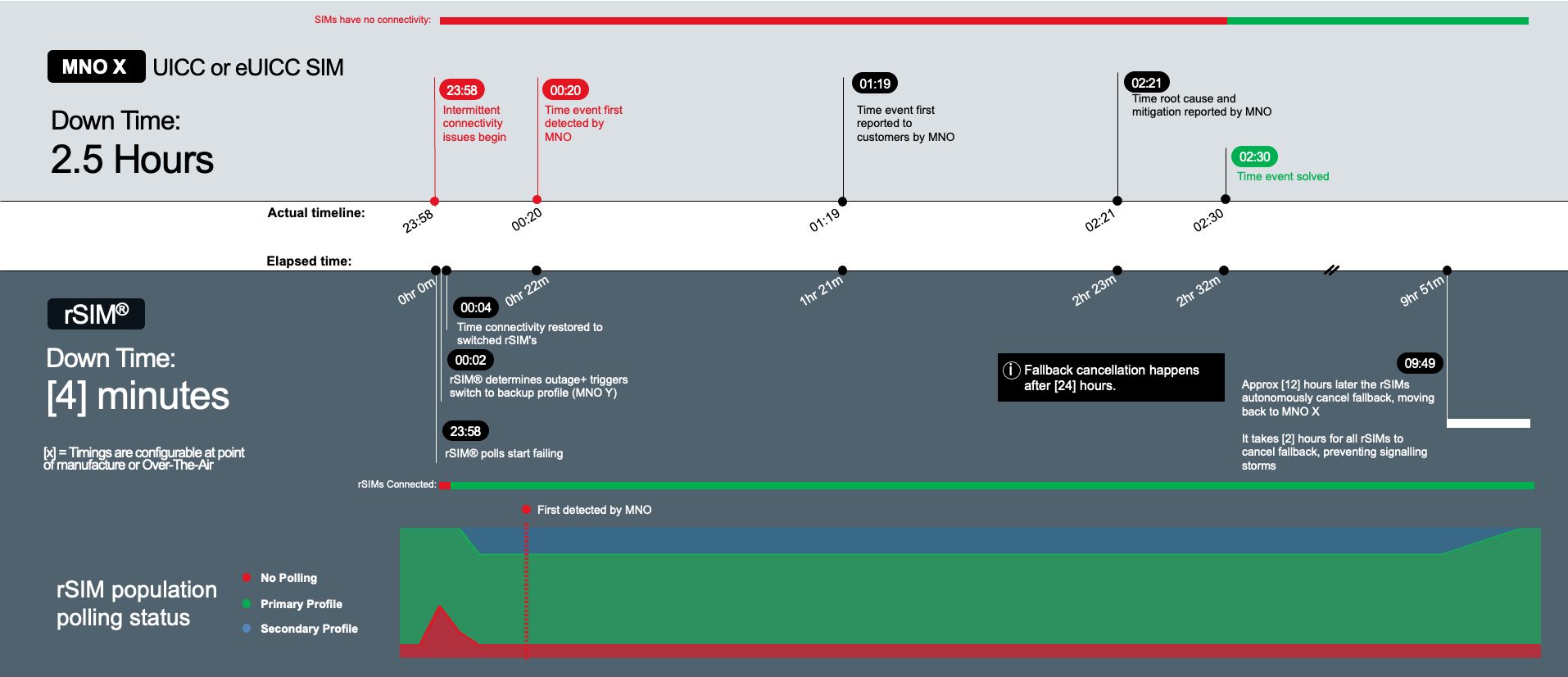
This transition took place within minutes and did not require any input from the device or external systems. Once the switch was complete, data transmission resumed and service continuity was maintained.
Key Findings from the Real Deployment Data
This outage provides a clear view of how connectivity behaves in real-world conditions, and where resilience makes a measurable difference. With the rSIM® network downtime can be reduced from hours to minutes. This example illustrates how a 2.5-hour period of no connectivity on a normal SIM was reduced to minutes using the rSIM®:
Not all connectivity issues appear as major outages. Many occur as short or intermittent failures that are difficult to detect but still disrupt service.
This data shows that even small to medium periods of instability can add up to meaningful downtime. By continuously validating the connection and responding in real time, rSIM ensures that these issues are addressed before they impact the end user.
Early Detection at the Edge
• rSIM identified connectivity issues before they were formally recognised at network level
• Detection was enabled by continuous polling of the data session
• Particularly effective during signalling-related and intermittent failures
• Highlights the difference between network visibility and real-time service performance at the device level
Hundreds of Critical Events Successfully Delivered
• Alerts were transmitted during the outage using the secondary profile at scale
• Each event relied on a functioning data connection
• Without rSIM, these alerts would have been at risk of failure
• Demonstrates the importance of maintaining service continuity in life or mission-critical applications
Downtime Reduced from Hours to Minutes
• Network-level outage duration: ~2.5 hours
• rSIM-affected downtime: ~4 minutes
• Failover occurred shortly after connection degradation was detected
• Reduced visible impact for end users and service providers
The Hidden Impact of Short Outages
• rSIM spent up to 0.5% of time on the secondary profile over a month
• Equivalent to approximately 3 hours 39 minutes of disrupted primary connectivity
• These were not always recorded as formal outages
• Still represent real periods where data was not reliably flowing
How MNOs go from Capability to Proven Performance
Resilience is often discussed as a feature. What this data demonstrates is how it performs in real conditions. rSIM continuously validates the connection, identifies when it is no longer working as expected, and maintains service by switching profiles when required. These actions are based on live deployment behaviour, not theoretical scenarios. As IoT deployments continue to scale, the ability to verify and maintain connectivity at the edge becomes increasingly important. Ensuring that a connection is actively working, rather than simply attached, is key to delivering reliable service.
Want to see the full data behind rSIM’s performance?
Download the rSIM Whitepaper to explore how dual-core SIM technology detects outages early, reduces downtime, and maintains connectivity across critical IoT deployments.
Download the Whitepaper:
 14 April 2026