
Why Testing the SIM Connection Matters
IoT Connectivity Issues:
Zero-Byte Sessions, Signalling Storms and IoT Downtime
In cellular IoT deployments, connectivity is typically judged by signal strength and network attachment. If a SIM is registered on a network and showing coverage, it is generally assumed to be operational. In reality, attachment does not guarantee that a data session is functioning correctly.
Traditional SIM solutions like single-profile SIMs, roaming SIMs, multi-IMSI configurations and many eUICC deployments rely primarily on successful network registration. Once attached, they mostly assume the session is active. What they do not do at a SIM level is continuously verify that upload and download paths are actually passing traffic.

This distinction becomes critical during partial or complex network failures.
Why IoT Network Failures Are Often Invisible
Not all outages are nationwide events. Many of the most disruptive failures are smaller in scale but equally significant for those affected. These can include core and regional network issues impacting specific services, regional transport or backhaul failures, DNS or routing problems, congestion events that create stalled or zero-byte sessions, or software updates affecting subsets of SIMs.
Because standard SIMs do not actively test their data path, they remain attached and inactive until the underlying issue is resolved centrally or the device forces a reset. For the end user relying on that connection, the impact is identical to a complete outage. Without active connection testing, the SIM has no mechanism to distinguish between a healthy data session and a stalled one.
This is the gap that rSIM was designed to address.
How rSIM Detects Zero-Byte Sessions and Stalled Data Paths
rSIM does not rely on attachment status as proof of connectivity. Instead, it performs continuous connection testing directly on the SIM. At defined intervals, the SIM verifies that both upload and download paths are functioning as expected. This polling takes place independently of device firmware and external cloud logic.
If data is not successfully passing, if the session becomes stale, or if zero-byte traffic is detected, rSIM confirms the failure before taking corrective action. Once validated, the SIM autonomously switches to its second mobile operator profile, which is linked to an entirely independent core infrastructure.
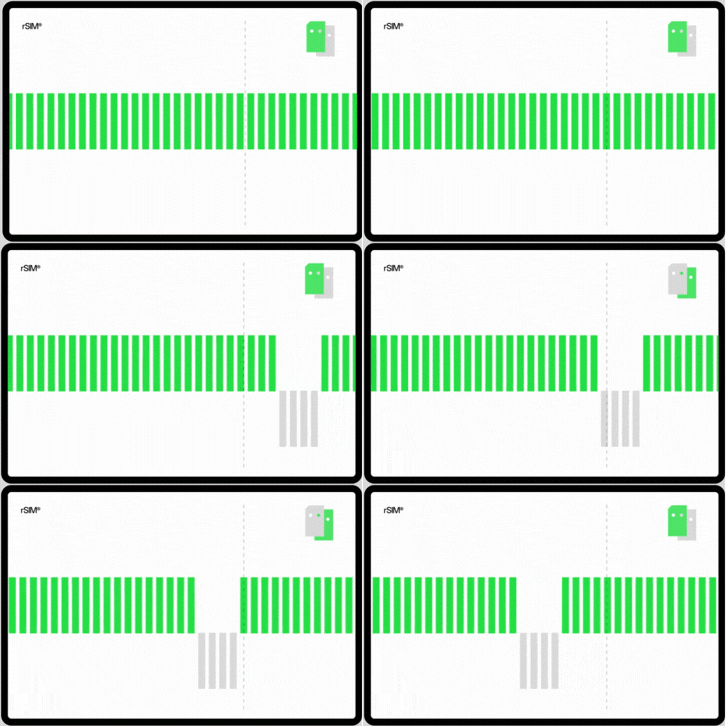
Because this intelligence resides on the SIM itself, no device intervention, manual reboot or external orchestration is required. The decision is made at the edge, where the consequence is felt.
The difference is reflected clearly in the outage comparison: while a standard SIM may remain offline for hours during a core or service failure, rSIM restores connectivity within minutes by detecting and responding to the issue in real time.
How rSIM Protects MNO Networks from Signalling Storms
Network restoration events often introduce a secondary challenge. When services return, large volumes of SIMs attempt to reattach simultaneously. This surge of signalling traffic, commonly referred to as a signalling storm, can overload network infrastructure and prolong instability.
Standard SIM behaviour typically involves repeated, uncontrolled reattachment attempts. rSIM’s approach is more controlled. By managing profile reversion in a structured way, rSIM reduces unnecessary signalling load. This not only restores service more efficiently for the end user but also protects the Mobile Network Operator’s core from excessive attach traffic and causing further issues.
Resilience must operate at both the device and network level to be effective.
Verified Uptime for Mission-Critical IoT Applications
In sectors such as telecare, emergency services, automotive, utilities and EV charging, connectivity underpins safety, revenue and operational continuity. In these environments, assuming that signal strength equates to service introduces unacceptable risk.
Since the launch of rSIM, real-world deployments have identified multiple instances of what could be described as “false positive” connectivity – where a SIM appears attached to the network but data is not successfully passing. Because rSIM continuously validates both upload and download paths, it is able to detect these stalled or zero-byte sessions in real time. In some deployments, this has resulted in rSIM operating on its secondary profile for up to 10% of total session time, despite no formal outage being reported at core network level. These are failures that would otherwise have gone undetected.
By actively testing connection paths and autonomously switching between independent cores when required, rSIM ensures that uptime is based on verified data flow rather than passive attachment. Connectivity is not inferred from signal visibility; it is confirmed through continuous validation.
To explore the data behind network fragility and understand how dual-core testing reduces downtime from hours to minutes, download the rSIM Whitepaper.
 26 February 2026